
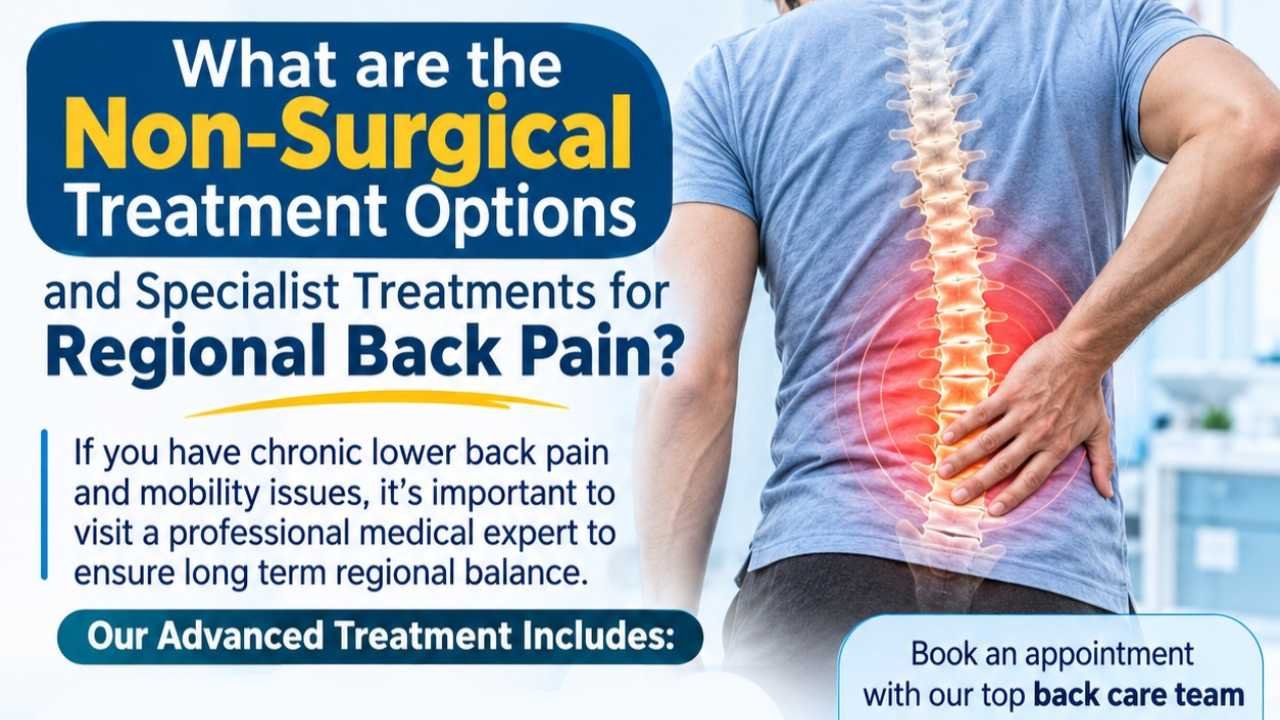
If you have chronic lower back pain and mobility issues, it’s important to visit a professional medical expert to ensure long term regional balance. Our advanced treatment includes specialist diagnostics, physio and rehabilitation. We also offer non-surgical treatment to help manage lifestyle related issues. Book an appointment with our top back care team to ensure you receive a private consultation and personal tracking of your wellbeing by a specialist.
What Are the Non-Surgical Treatment Options and Specialist Treatments for Regional Back Pain?
Back pain is one of the most common health concerns affecting people of different age groups. Whether it develops in the upper back, middle back, or lower back, persistent discomfort can interfere with everyday activities, work, sleep, and overall quality of life. While many people assume that surgery is the only solution for severe or long-standing back pain, several effective non-surgical treatment options are available.
With advances in pain medicine and interventional pain management, patients can explore specialised treatments designed to reduce pain, improve mobility, and address the underlying source of discomfort without immediately undergoing surgery.
The right back pain treatment depends on identifying its underlying cause. A personalised, non-surgical pain management plan may help many patients achieve meaningful relief and return to their daily activities.
Understanding Different Types of Regional Back Pain
Back pain can originate from muscles, joints, spinal discs, ligaments, or nerves. Understanding the affected region and identifying the pain generator are important steps towards selecting the right treatment.
- Upper Back Pain: Pain between the shoulders or around the thoracic spine, which may be associated with muscular strain, poor posture, or joint-related problems.
- Middle Back Pain: Discomfort around the thoracic region that may originate from muscles, spinal joints, discs, or chest wall structures.
- Lower Back Pain: Pain around the lumbar spine, sometimes associated with disc problems, facet joint arthritis, muscle strain, or sacroiliac joint dysfunction.
- Back Pain with Sciatica: Shooting or radiating pain that travels from the lower back through the buttock and down the leg, often due to irritation or compression of a spinal nerve.
What Are the Non-Surgical Treatment Options for Back Pain?
Most back pain conditions can initially be managed through conservative treatment approaches. The treatment plan depends on the patient's symptoms, medical history, physical examination, and diagnostic findings.
1. Medications for Pain Relief
Depending on the cause and severity of pain, doctors may recommend appropriate medications such as anti-inflammatory medicines, muscle relaxants, or medicines for nerve-related pain. Medication selection should always be guided by a healthcare professional, particularly when symptoms persist.
2. Physiotherapy and Rehabilitation
Physiotherapy plays an important role in managing many back pain conditions. Individualised exercises can help strengthen the supporting muscles, improve flexibility, correct movement patterns, and support spinal stability. A structured rehabilitation programme can also help reduce the risk of recurring episodes.
3. Posture Correction and Lifestyle Modifications
Poor sitting habits, prolonged screen time, improper lifting techniques, and lack of physical activity can contribute to back discomfort. Maintaining proper posture, taking regular movement breaks, staying physically active, and maintaining a healthy weight can support long-term back health.
4. Minimally Invasive Interventional Pain Management
When conventional treatments do not provide sufficient relief, specialised pain management procedures may be considered. These targeted treatments aim to reduce pain signals, address specific pain-generating structures, and improve functional ability without major surgery.
Specialist Treatments for Regional Back Pain
Interventional pain management offers several minimally invasive procedures for selected patients with chronic or difficult-to-manage back pain. These procedures are generally performed using imaging guidance to improve accuracy and target the affected area.
Epidural Steroid Injections
Epidural steroid injections deliver anti-inflammatory medication into the epidural space around the spinal nerves. They may help selected patients experiencing back pain associated with nerve irritation, disc herniation, or spinal stenosis.
Facet Joint Injections and Medial Branch Blocks
Facet joints are small joints connecting the bones of the spine. When these joints become a source of pain, targeted injections or medial branch nerve blocks may help identify and manage facet-related discomfort.
Radiofrequency Ablation (RFA)
Radiofrequency ablation uses controlled heat to interrupt pain signals carried by selected nerves. It may be recommended for appropriately diagnosed facet joint-related back pain, particularly when diagnostic nerve blocks indicate a favourable response.
Transforaminal Epidural Injections
This targeted injection delivers medication near a specific spinal nerve root. It may be considered for patients experiencing radiating leg pain or sciatica caused by nerve irritation or compression.
Caudal Epidural Injections and Neuroplasty
Caudal epidural injections deliver medication through the lower end of the spinal canal. In selected patients with persistent pain, particularly where epidural scarring or adhesions are suspected, caudal neuroplasty may also be considered.
Myofascial Trigger Point Injections
Muscle knots or trigger points can contribute to localised back pain and muscle tightness. Trigger point injections may help relieve discomfort in selected patients when muscular pain is identified as the primary source.
Can Back Pain Be Treated Without Surgery?
Yes, many patients with back pain, disc-related symptoms, or sciatica can be managed without surgery. Depending on the diagnosis, treatment may include medications, physiotherapy, rehabilitation, targeted nerve injections, epidural steroid injections, or radiofrequency procedures.
However, non-surgical treatment is not suitable for every condition. Patients with certain neurological problems, progressive weakness, spinal instability, or other serious structural conditions may require surgical evaluation. The decision should be made after a detailed clinical assessment.
Meet Dr. Saipriya Tewari – Pain Management Specialist
Dr. Saipriya Tewari is a Principal Consultant and Unit Head – Pain Management and Palliative Care at Max Super Speciality Hospital, Dwarka, New Delhi. She specialises in comprehensive pain management and advanced interventional pain procedures.
With qualifications including MBBS, MD in Anaesthesiology, PDCC in Pain Management, Fellowship in Interventional Pain Practice, and National Fellowship in Palliative Medicine, Dr. Tewari follows a multidisciplinary, patient-centred approach to managing complex pain conditions.
Her expertise in chronic low back pain includes lumbar epidural steroid injections, caudal neuroplasty, lumbar facet radiofrequency ablation, and other targeted pain management interventions. Her approach focuses on identifying the source of pain and developing an individualised treatment strategy to improve comfort, mobility, and quality of life.
When Should You Consult a Pain Management Specialist?
You should consider consulting a specialist if you experience:
- Back pain that continues for several weeks or keeps returning.
- Pain radiating from the back into the buttocks or legs.
- Burning, tingling, numbness, or shooting sensations.
- Difficulty sitting, standing, walking, or performing everyday activities.
- Insufficient relief from conventional treatments.
Seek urgent medical attention if back pain is accompanied by new bladder or bowel control problems, numbness around the groin or saddle area, or progressive leg weakness. These symptoms may indicate serious nerve compression.
Take the First Step Towards Better Back Pain Management
Living with persistent back pain can affect your physical health, emotional well-being, and independence. Fortunately, surgery is not the only treatment option for many back pain conditions. With an accurate diagnosis and the right combination of conservative care and specialist interventions, patients may achieve meaningful pain relief and improved mobility.
Consulting an experienced pain management specialist like Dr. Saipriya Tewari can help you understand your treatment options and explore personalised, non-surgical approaches to managing regional back pain.
Don't Let Back Pain Limit Your Life
Explore personalised, non-surgical back pain treatment options with Dr. Saipriya Tewari and take a step towards better mobility and improved quality of life.
Medical Disclaimer: This information is intended for educational purposes only and should not replace professional medical advice, diagnosis, or treatment. Treatment options and suitability vary depending on individual medical conditions and clinical assessment.